Computed tomography (CT) is now part of what many radiography programmes are expected to teach, yet scanner time for students is scarce. This article sets out what the main professional frameworks expect of graduates in CT, the challenges programmes report, and where simulation can help.
Key points
- In the UK, standard head CT has long featured in the indicative pre-registration curriculum. In Ireland, graduates must know the clinical application of CT and gain experience assisting with CT examinations.
- In the USA, CT principles are optional content in entry-level radiologic technology programmes, and CT is a specialisation after graduation. In Australia, performing CT is a professional capability for registration as a diagnostic radiographer.
- Programmes report limited scanner access and limited CT placement experience. Simulation is well received and improves knowledge, although evidence on long-term transfer to practice is still developing.
What graduates are expected to know
Expectations differ by country, but the direction is the same: graduates need a working understanding of how CT images are acquired, reconstructed, and evaluated.
|
United Kingdom and Ireland
In the UK, the College of Radiographers' indicative curriculum for pre-registration diagnostic radiographers lists techniques for mainstream CT procedures, including standard head CT, CT of the spine, chest, and abdomen in acute trauma, and standard contrast examinations [1]. In Ireland, CORU's revised standards for radiography programmes, in effect since April 2025, require graduates to know the clinical application of CT and to gain experience assisting with CT examinations [2].
|
|
United States
The ASRT Radiography Curriculum includes Basic Principles of Computed Tomography as optional content: scanner types, image formation, CT numbers, artefacts, window level and width, reconstruction, and dose measures such as CTDI and dose length product [3]. CT itself is a post-primary specialisation.
|
|
Australia
The Medical Radiation Practice Board of Australia includes performing CT imaging among the professional capabilities for diagnostic radiographers. This covers operating CT systems safely, applying imaging parameters for each patient, performing contrast and non-contrast examinations, and processing image sets, including multiplanar reformats [4, 5].
|
The challenge: CT is hard to practise
A 2026 review of 13 studies on CT education for radiography students found that access to CT scanners for teaching is costly and resource-intensive. Students reported limited CT exposure on placement, nervousness, and in some cases limited engagement from busy clinical staff [6].
CT is also difficult to learn by watching. The decisions that shape image quality, such as scan range, protocol, reconstruction filter, and window settings, happen quickly on a busy list, and a student rarely gets to change one setting and see what it does.
Where simulation fits
Most CT teaching for students now happens on campus, using tutorials, scanner simulators, virtual reality software, and remote-access systems. The same review found that simulation was generally well received and improved knowledge, with one included study reporting significantly greater knowledge gains for students who had simulator access [6].
Simulation gives students the repetition that clinical lists cannot. They can run the same examination several times, change one decision at a time, and see the effect on the images, without exposing anyone to radiation or holding up a department.
Simulation prepares students, it does not replace placement
The review authors note that clinical education remains important for developing knowledge and skills, and that the evidence does not yet support a definitive set of best practices. Supervision and feedback make simulation more effective, so it works best built into teaching, not left as self-study alone [6].
What to look for in a CT simulator
The full workflow, not just image viewing
Students should prepare and position the patient, acquire a scout image, plan the scan, choose a protocol, and reconstruct the images, in the order they will meet in practice.
Images that respond to decisions
If images come from a fixed library, students learn to recognise pictures. If images are generated from the decisions students make, they learn why the image looks the way it does.
Reconstruction and windowing
Filters, window width and level, and multiplanar reformats are central to CT image quality and appear across the frameworks above. Students need to practise them, not just read about them.
Easy to deploy
Software that runs on standard computers lets a whole cohort practise at the same time, on campus or remotely, without dedicated hardware.
How CT Pro VR supports CT teaching
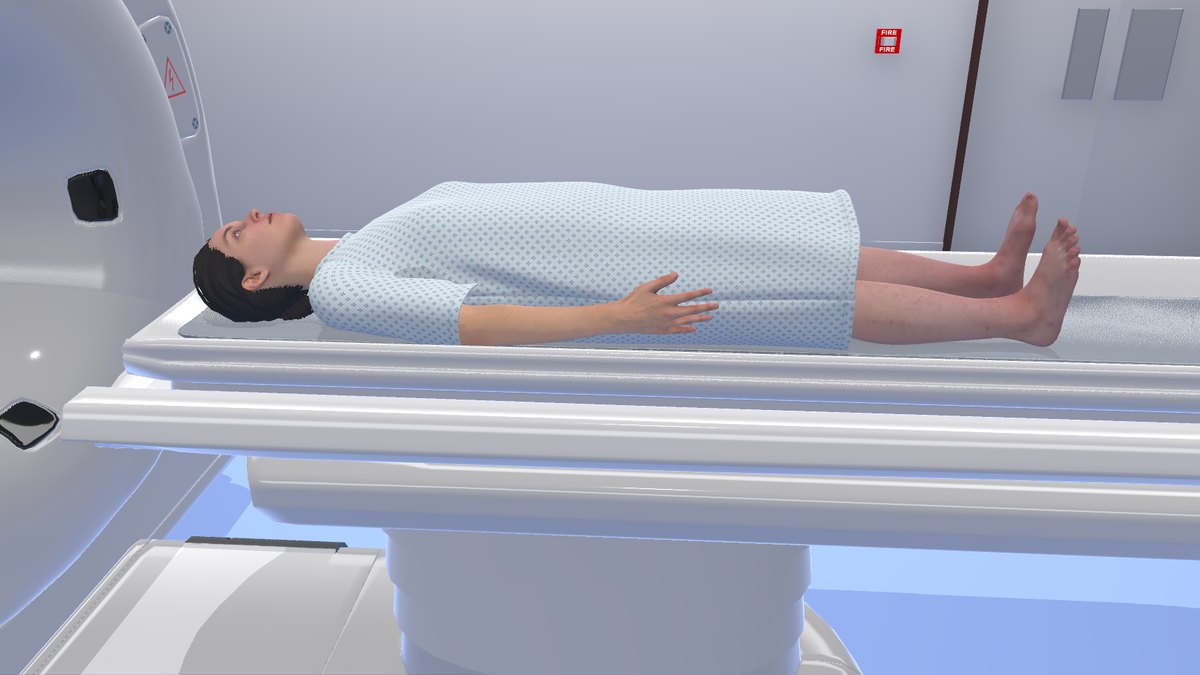
CT Pro VR is a CT simulation for radiography and radiologic technology education from Virtual Medical Coaching. The first release covers CT head examinations, with further body regions to follow [7].
- Patient preparation and positioning for CT head examinations.
- Scout image acquisition and scan planning.
- Protocol selection and configuration.
- Image reconstruction, including filters, windowing, and multiplanar reformats.
- Every CT image is generated by a physics-based engine, not taken from a library of pre-recorded scans, so each decision changes the result.
CT Pro VR was developed with clinical subject-matter review. It runs on Desktop (Windows and Mac) and is available to order now, with general release in January 2027.
Desktop
Frequently asked questions
Do undergraduate radiography programmes have to teach CT?
It depends on the country. In the UK, standard head CT features in the indicative pre-registration curriculum. In Ireland, graduates must know the clinical application of CT and gain experience assisting with CT. In the USA, CT principles are optional content in entry-level radiography programmes. In Australia, CT is a professional capability for registration as a diagnostic radiographer.
Can simulation replace CT clinical placement?
No. Simulation prepares students so they get more from their placement time, but clinical education remains essential.
What does CT Pro VR cover?
The first release covers CT head examinations: positioning, scout acquisition and scan planning, protocol selection, and reconstruction, including windowing and multiplanar reformats. Further body regions will follow.
When is CT Pro VR available?
It is available to order now, with general release in January 2027. It runs on Desktop (Windows and Mac).
References
- College of Radiographers. Education and Career Framework for the Radiography Workforce. Indicative curriculum for practitioners. sor.org
- CORU Radiographers Registration Board. Public consultation report on revised criteria and standards of proficiency for radiographers. May 2024. coru.ie
- American Society of Radiologic Technologists. Radiography Curriculum. 2022. asrt.org
- Medical Radiation Practice Board of Australia. Professional capabilities for medical radiation practitioners. medicalradiationpracticeboard.gov.au
- Medical Radiation Practice Board of Australia. Professional capabilities for medical radiation practice, 2nd edition. 2020. Domain 1A, key capability 3.
- Jimenez YA, Gray F, Chau M, Jerjen F, Repole A, Abu Awwad D. Approaches to computed tomography education for radiography students. J Med Radiat Sci. 2026. doi.org/10.1002/jmrs.70061
- Virtual Medical Coaching. CT Pro VR: CT simulation software. virtualmedicalcoaching.com